Dumbwaiters
Small service lifts for restaurants and hotels.
Small service lifts for restaurants and hotels.
Compact lifts for carrying dishes, tableware and food between kitchen and dining-room floors. They are installed in a small shaft and need no machine room.
Request a dumbwaiter quoteFormally, a dumbwaiter is a small goods lift, in regulatory terms a "Class V service lift": rated load up to 250 kg, a car floor area of about one square metre and a car height of about 1.2 m. The dimensions are chosen so that a person physically cannot get inside. That is exactly why such a lift falls under a simplified regime - we confirm the specific requirements for your model against its data sheet. Models rated at 300 kg do appear in price lists, but they fall outside this class, and the requirements differ too.
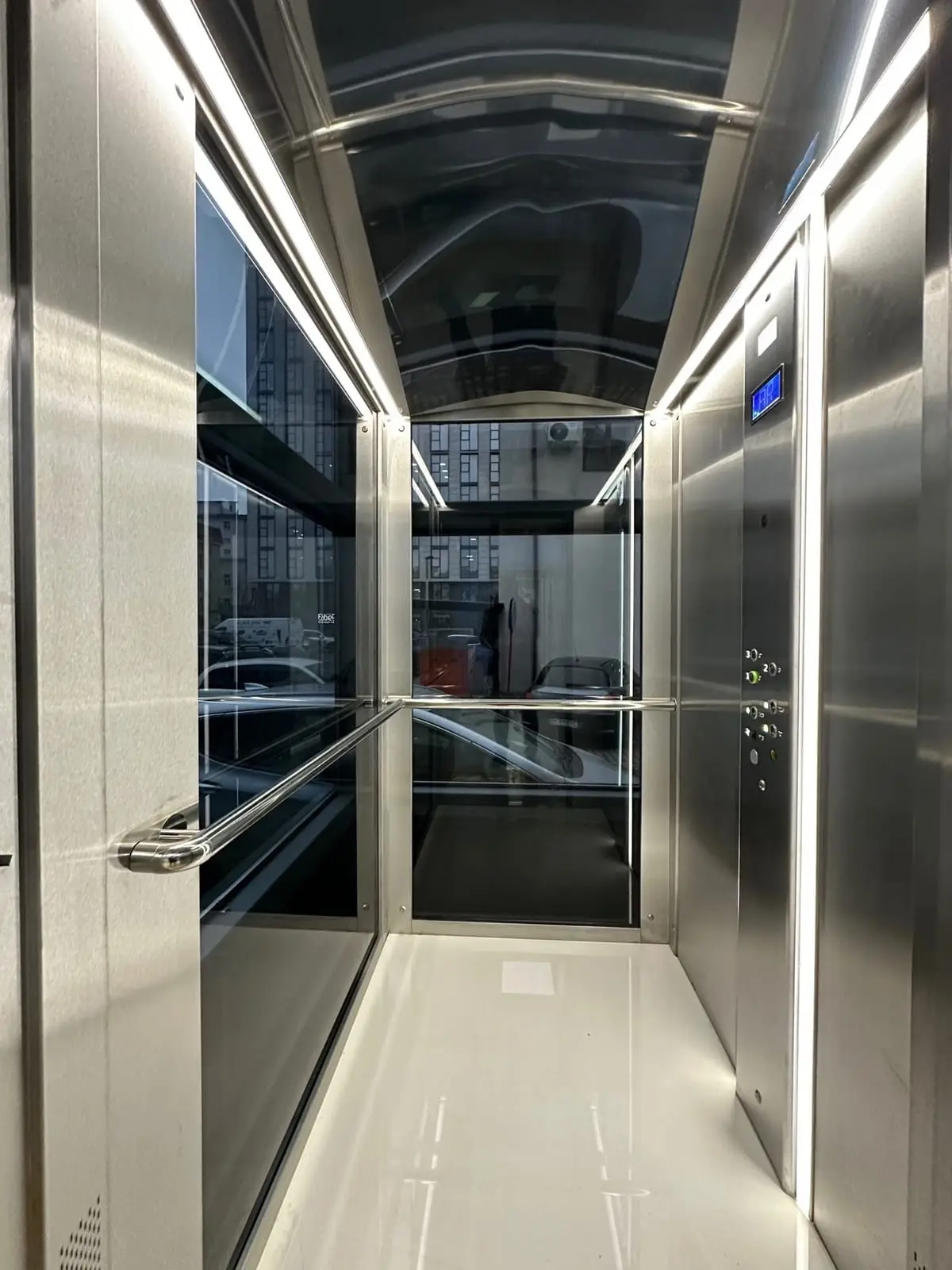
The car is made of stainless steel with removable shelves: it is washed every day, and any painted steel in a kitchen does not last long. We set the loading opening at worktop height so the waiter does not have to bend down with a tray. The landing doors are most often vertical sliding guillotine doors - they need no room for swinging leaves and do not block the narrow aisle of the hot kitchen.
The most expensive part of the job is not the lift itself but the opening in the floor slab. That is why the shaft needs discussing while the restaurant is still on the drawing board, not once the hot-kitchen equipment is already in place. In an existing building we come on site, look at the floor slabs, services and escape routes - and only then say whether the shaft can realistically go exactly where the chef wants it.
What a dumbwaiter does not do: carry people - never, under any circumstances; this is not a formality but a matter of life and death. Nor is it a conveyor: a cycle with loading and unloading takes longer than it looks on the plan. If the flow is heavy, it is more honest to plan two lifts or go straight for a shaft sized for a larger goods lift.
Small service lifts with a rated load of up to 250 kg that a person cannot enter are not classed as lifts under Ukrainian occupational safety regulations (NPAOP) and do not require registration. However, installation must follow the design documentation, and the equipment must have a declaration of conformity.
No. The car is deliberately made so that nobody can get in, and it has no passenger protection devices at all: no safety gear rated for a person's weight, no two-way communication, no lighting. Trying to ride in such a lift ends in injury or worse. This is the strictest operating rule, and staff must know it from day one.
Not much: the car size plus guide rails and clearances on each side, and the smallest cars start at about 500 × 500 mm. Above the top stop, space is allowed for the traction machine and pulleys; below, a small pit, and sometimes none at all when the bottom stop is at floor level. The manufacturer provides exact dimensions for the specific model, and you need them before the floor slab is poured.
No. The dumbwaiter drive is compact and sits at the top of the shaft or in a small recess nearby. All it needs is maintenance access - a removable panel or hatch you can reach without taking the wall apart. Allow for this in the interior design: otherwise an access hatch in the middle of expensive cladding comes as a surprise after the fit-out.
The lift shaft is a vertical duct, and without ventilation it draws hot-kitchen smells into the dining room. The fix is simple: extraction from the top of the shaft, tight-fitting doors with seals, and staff discipline - never leave the car standing in the kitchen with dirty dishes. The stainless steel car is washed daily, shelves included.
The approach is the same as for an ordinary lift, only the scope is simpler: checking the ropes or chain, brake, limit switches, door interlocks and the condition of the guide rails. In a restaurant the equipment runs every day in a humid environment, so inspections are best not postponed. We take on maintenance of these lifts together with the rest of the site's lift equipment.
Vertical and inclined platform lifts for barrier-free access.
For residential buildings, offices, hotels and public buildings.
For warehouses, factories, shopping centres and kitchens.
For hospitals and medical centres: sized for stretchers and intensive care beds.
What determines the choice of lift: building type, number of floors, rated load, drive type and whether there is a machine room. Practical guidelines and common mistakes.
7 min readWhy the price is not quoted over the phone, which items actually make up the cost of a lift replacement, what drives the cost up and which benchmark you can check in the open register.
9 min readChoose what you need: an engineer will contact you within one working day, select a model and calculate the cost.
Or just give us a call: +38 (050) 585-39-28 ·+38 (063) 283-31-48 ·+38 (096) 901-76-50