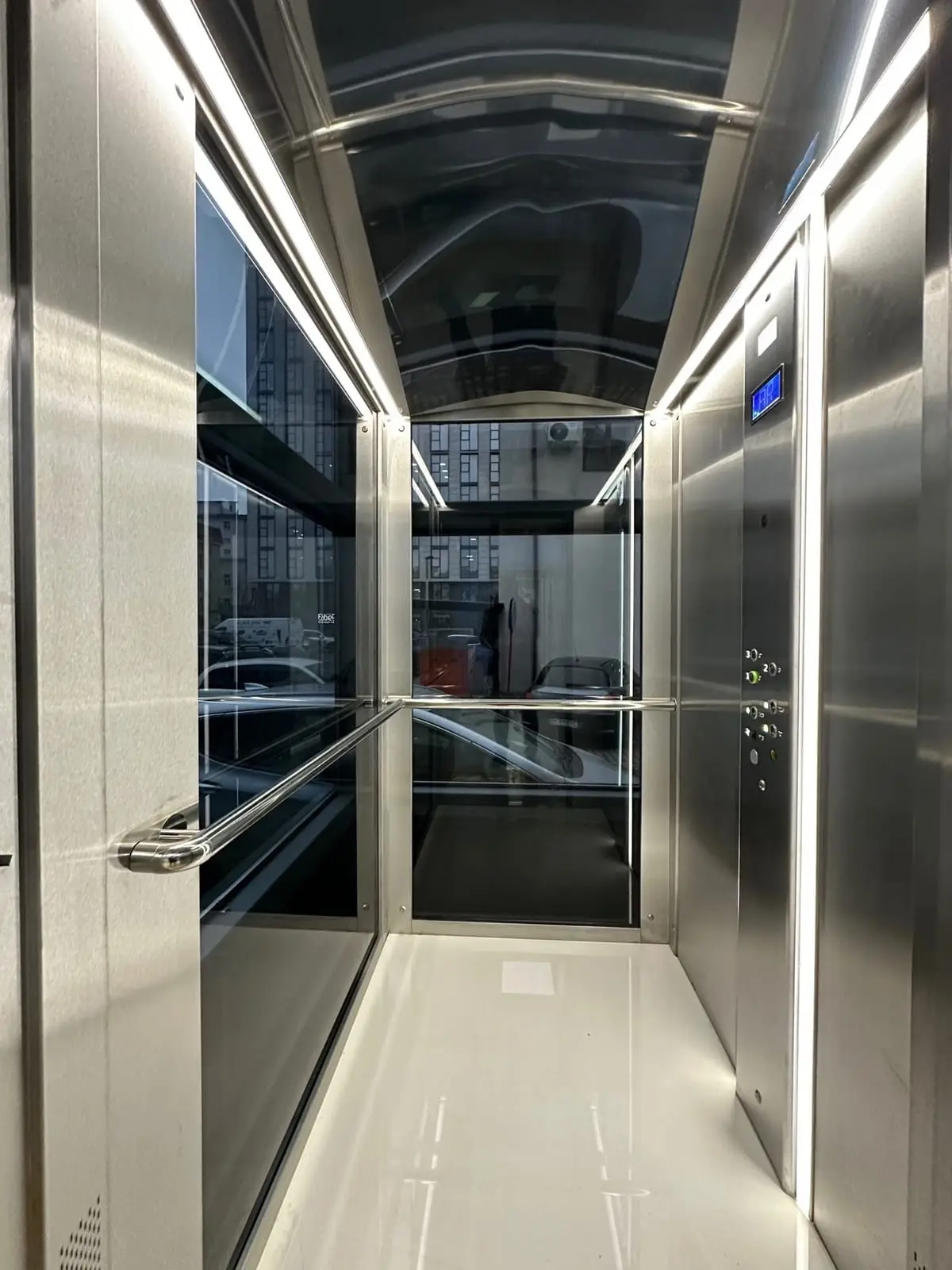
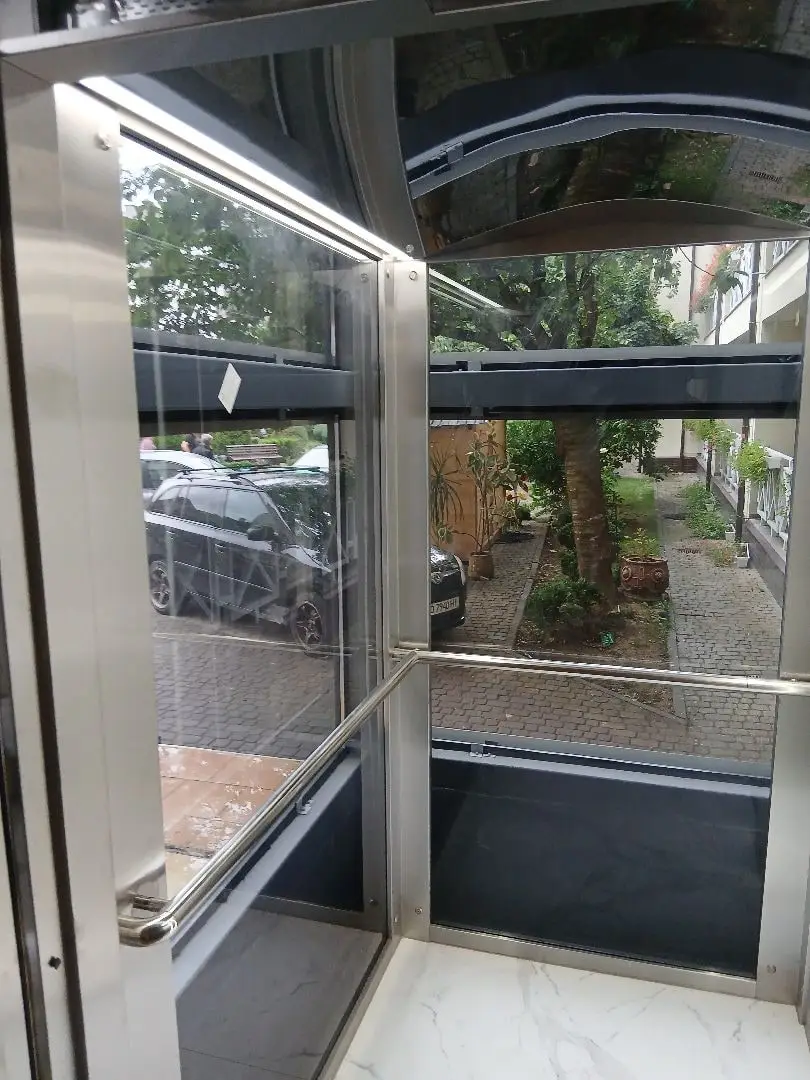
"How much does it cost to replace a lift?" is the question almost every conversation starts with. The honest answer is an awkward one: until someone has seen the shaft, any figure quoted is a guess. Below we explain what really makes up the contract amount, what changes it the most, and the one benchmark we can offer in a form you can actually verify.
Why we don't quote a price over the phone
Take two apartment-block entrances with the same number of floors. In the first, the shaft is dry and true: all that is needed is to remove the old equipment and install the new one. In the second, the pit floods, the walls are crumbling, the power supply is at its limit, and the embedded fixings for the guide rails will have to be reinforced. The equipment can be identical in both cases, yet the contract amounts will differ several times over. That is why a figure quoted before a site visit holds only until the first trip down into the pit.
The second reason is dimensions. A building is designed on paper but built by hand, and the actual shaft rarely matches the drawing to the centimetre. Until those centimetres have been measured with a tape, nobody knows whether standard equipment will fit the shaft, whether a retrofit version is needed, or whether the pit will have to be deepened and the headroom altered. These are three scenarios with very different costs, and the choice between them is made by the site survey, not by a conversation.
That is why the engineer first asks for four things: the internal plan dimensions of the shaft, the pit depth, the headroom height and the number of stops. If this information is not available, the engineer comes out and measures it in person.
What makes up the price
The most common misconception is that replacing a lift costs the same as the lift itself. The machine is often the smaller part of the cost: the rest comes from the work around it, and that is exactly what varies from one project to the next.
| Cost item | What lies behind it |
|---|---|
| Equipment | Car, traction machine, guide rails, landing and car doors, controller, counterweight. The biggest influences on cost here are rated load, drive type and finishes |
| Dismantling the old lift | Dismantling the equipment, lowering it out of the shaft and machine room, removal and handing in the metal for scrap. In a narrow stairwell this is a significant labour cost in its own right |
| Shaft preparation (building works) | Repairs to walls and floor slabs, embedded fixings for the guide rails and, if required, deepening the pit or altering the headroom |
| Pit waterproofing | Needed wherever the pit floods, and essential where the groundwater level is high. Otherwise the new equipment starts to rust within the first season |
| Electrical work | A dedicated power supply line with a circuit breaker, shaft and pit lighting, a socket outlet and switch in the pit, ventilation of the shaft and machine room |
| Installation | The crew's work in the shaft: installing the guide rails, car, counterweight, doors and drive, and laying the cables |
| Commissioning | Setting up the controller, adjusting stopping accuracy, static and dynamic tests |
| Technical inspection and putting into operation | Acceptance of the work, paperwork, registration of the equipment, handover of the technical passports to the client |
| Remote monitoring | Communication with the car and equipment status monitoring from a dispatch console. Required under the operating regulations, yet it is the item most often left out of the budget |
Two items on this list are almost always underestimated. The first is pit waterproofing: it does not show in photos of the finished lift, and nobody worries about it while the pit is dry. The second is technical inspection and putting into operation: it does not depend on the installation crew at all, because the timing is set by the inspection body's schedule. It is this, not the installation, that most often delays project handover.
What makes the job more expensive
- Non-standard shaft dimensions. If standard equipment does not fit, the choice narrows to a retrofit version, a change in rated load or alterations to the shaft itself - and each option has its own cost.
- An external (add-on) lift shaft. When the building has never had a lift, this is no longer an installation but a construction project: design, foundations, steel frame, glazing, wall junction details and approval from the planning authority.
- A listed heritage building. The heritage protection authority becomes involved, and with it come design solutions that have to be defended before the approving body rather than simply picked from a catalogue. This stage regularly takes longer than the installation itself.
- An occupied building. Work is carried out in an entrance that people use every day: restricted working hours, protection of the stairwell, and residents notified according to a schedule. Where there is only one lift in the entrance, the schedule becomes even tighter.
- A hospital that stays open. A hospital block cannot be left without vertical transport, so the equipment is replaced one lift at a time rather than all at once. The same work in an empty building would be faster and cheaper.
- Car finishes and additional car equipment: coloured or mirror-finish stainless steel, a full-height car operating panel (COP), displays at every landing.
The only honest benchmark we can give
We have no price list for lift replacement, and we do not publish "from" prices: for any specific shaft such a price almost always turns out to be untrue. What we do have is something a supplier rarely offers - our own contracts in an open public register. As of the end of July 2026, there are 163 signed contracts worth UAH 202,800,000 with 42 clients, from 2016 to 2026. All of them can be found in Prozorro under EDRPOU code 33860532, showing the client, subject, date and amount of each.
| Project and contract number | Amount, rounded down |
|---|---|
| Major overhaul of lift equipment, Ivano-Frankivsk Regional Children's Clinical Hospital (municipal non-profit enterprise), 132 Yevhena Konovaltsia St. - UA-2026-05-22-011304-a | UAH 18,100,000 |
| Reconstruction of dormitory premises with an add-on lift shaft, 73 Stryiska St., Lviv, Western Directorate of the Works Client - UA-2024-04-11-012656-a | UAH 6,400,000 |
| Installation of a hospital (bed) lift with construction of a steel-frame shaft, Storozhynets Multidisciplinary Intensive Care Hospital (municipal non-profit enterprise) - UA-2023-08-05-000365-a | UAH 4,700,000 |
| External lift for a listed heritage building, 1 Hrushevskoho St., Chernivtsi, Municipal Enterprise "Directorate for Servicing Jointly Owned Property of Territorial Communities" - UA-2026-06-26-011590-a | UAH 4,000,000 |
Now the most important point, without which this table is misleading. These are not lift prices. Each of these contracts is a major overhaul or reconstruction, and the amount covers the entire scope: building works, structures, interior finishes, electrical work and, in some cases, building a shaft from scratch or restoration work on the facade. These figures cannot be applied directly to your own building - the error would be several-fold, and in either direction.
Even a contract title that explicitly names the lift and its rated load does not help. A major overhaul with the installation of a 1275 kg passenger lift serving 4 stops for the municipal City Children's Outpatient Clinic in Chernivtsi (UA-2025-05-05-014034-a) came to UAH 2,500,000. A repair with identical wording and a 1000 kg lift serving 5 stops at the municipal Zastavna Multidisciplinary Hospital (UA-2021-07-13-009560-c) came to UAH 1,500,000. Comparing these two amounts with each other makes no sense either: different years, different buildings and a different scope of building work behind the same word "repair".
The value of the register lies not in the figures themselves but in the ability to check them. You can see who the client is, what was procured, when the contract was signed and for how much - and compare that with what you are being told. That is more honest than a "from" price that can neither be verified nor held against anyone later.
How to get a figure for your building
- Send us whatever you have: the number of stops and floors, the internal plan dimensions of the shaft, the pit depth and the headroom height. If you don't have this information, the address, number of floors and type of building will do.
- Tell us what is installed now: the manufacturer and the approximate year the old lift was installed. This immediately narrows down the replacement options.
- We arrange a site visit. The engineer takes the actual measurements and checks the condition of the shaft, pit, embedded fixings and power supply. This is where it becomes clear how much of the total will be equipment and how much building work.
- Based on the site survey, you receive a cost breakdown that shows exactly what the total includes, rather than a single figure at the bottom of the page.
We carry out the site survey and quote free of charge, regardless of how the conversation ends. If the assessment shows that modernization makes more sense than full replacement, we will tell you: the difference in cost is substantial, and there is no point hiding it.