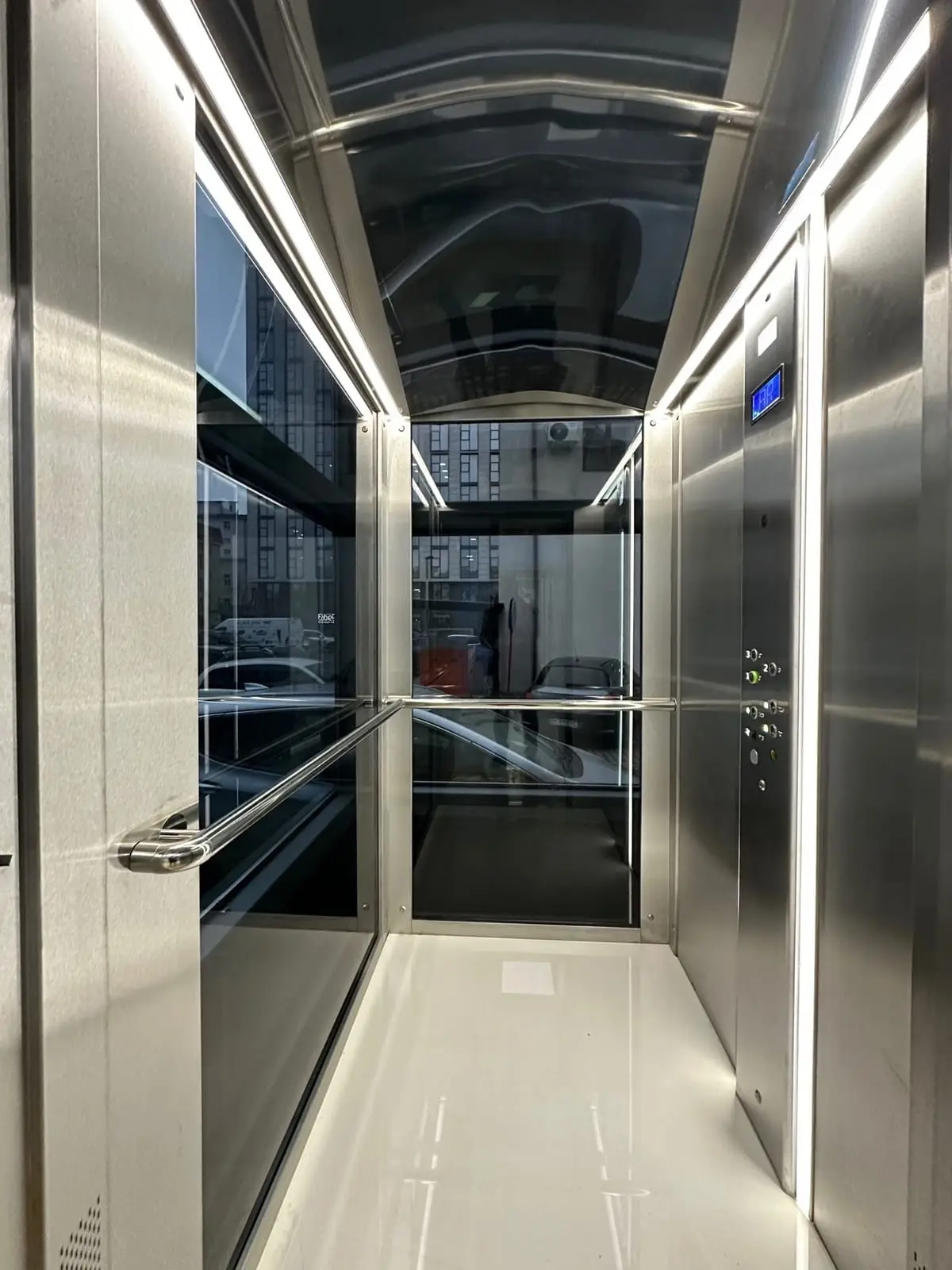
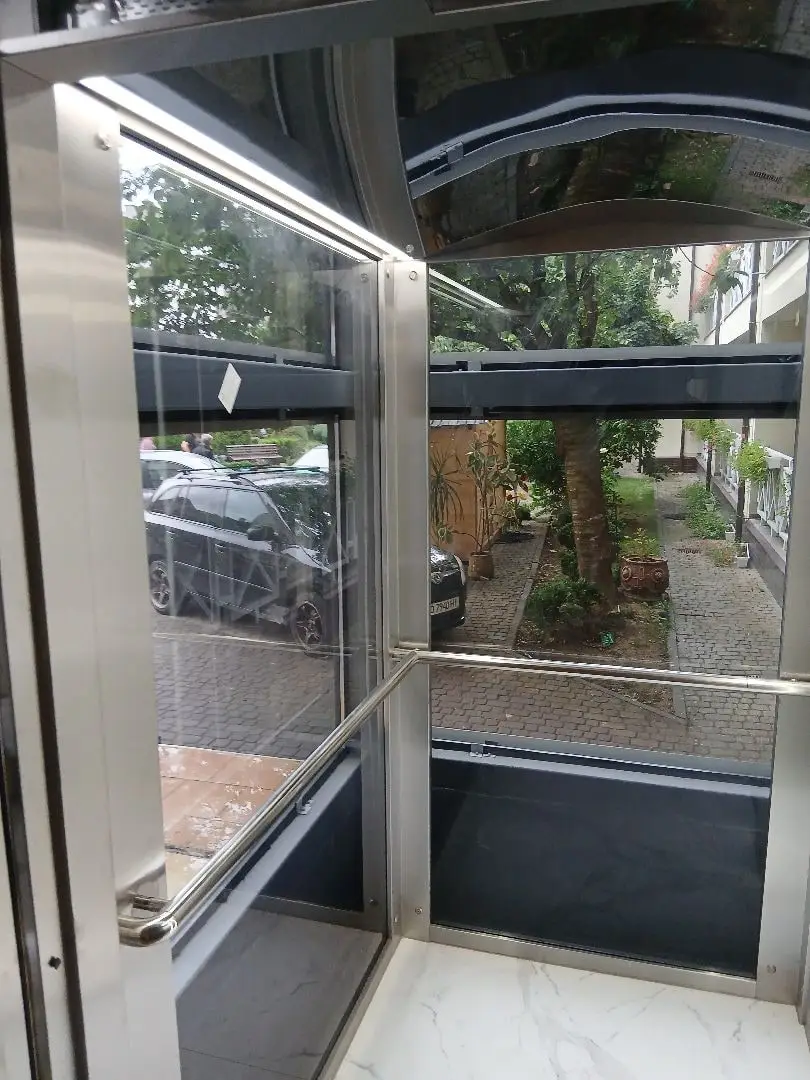
Machine-room-less (MRL) lifts
MRL - the equipment is housed inside the shaft.
MRL - the equipment is housed inside the shaft.
The traction machine and controller are located at the top of the shaft, so no rooftop structure is needed. They reduce building height and, thanks to the gearless drive, power consumption.
Get a quote for an MRL liftLook inside an MRL lift and it becomes clear how the room disappeared. The synchronous permanent magnet machine runs without a gearbox or an oil bath, so it is flat: it is mounted on the guide rails or on a beam at the top of the shaft. The control cabinet is built into the door frame on the top floor or into a wall recess nearby, behind a removable panel. That is all that remains of the former machine room.
Some manufacturers use flat polyurethane belts with steel cords inside instead of round ropes - the Otis Gen2 has twelve such cords. A belt bends around a much smaller sheave, so the machine is compact, and the suspension means needs no lubrication at all. But this is not a feature of every MRL: many models run on conventional ropes of smaller diameter, and when choosing a lift you should ask specifically about the suspension means - it determines the service life, the replacement cost and who will actually be able to carry out the replacement.
The trade-off is maintenance and noise. The technician works not in a dry, lit room but from the car roof or through an inspection hatch: the shaft is stuffy in summer and cold in winter, and removing the machine for repair is harder. Evacuation is done not by turning a handwheel but from the emergency operation panel next to the landing doors, and site staff need separate training for this. The machine has also moved closer to the flats adjoining the shaft: vibration isolation of the mountings and accurate guide rail installation matter more here than in the classic layout. Do a sloppy job and residents on the top floor will hear every start.
It is a lift whose traction machine and control cabinet are housed in the shaft itself - usually at the top or beside the guide rails. No separate room above the shaft is needed, so the building can be lower and the usable roof area stays free.
Sometimes yes, sometimes it needs rework. Three dimensions decide it: shaft width and depth, the height from the top landing level to the slab above, and pit depth. Old shafts were built for a geared machine in a machine room, and they often have less clearance at the top than an MRL requires. We come out and measure the actual shaft - we don't make decisions based on old drawings.
Using the emergency operation device: a panel with a removable key next to the landing doors lets you move the car slowly to the nearest landing and open the doors. This used to be done with a handwheel in the machine room; now it is done right from the floor. The procedure must be known not only by our emergency crew but also by the responsible member of staff on site.
The main saving comes from the gearless drive with variable frequency control: there are no gearbox losses, the starting current is lower and speed is controlled smoothly. Manufacturers claim up to 40% compared with a geared machine, but the real figure depends on the load and the number of trips. LED lighting that switches off in standby is also fitted, and energy regeneration back to the grid is available as an option.
Most often it is built into the door frame at the top landing or into a wall recess nearby - behind a panel that opens with a key. This has to be taken into account at the finishing stage: the technician needs clear working space in front of the cabinet, so furniture, cupboards or signs must not be placed there. Unfortunately, people usually remember this only after the refurbishment.
The equipment itself usually costs more. But you need to compare the full cost: a machine room means walls, a floor slab, doors, ventilation, lighting, a separate entrance and lost usable space at the top. When a developer adds it all up, the difference mostly disappears, and MRL also saves on building height.
Low travel, high rated load, quiet operation.
Small service lifts for restaurants and hotels.
Vertical and inclined platform lifts for barrier-free access.
For residential buildings, offices, hotels and public buildings.
MP lifts from Seville: in-house electronics and traction machines, an open (non-proprietary) controller, EU certificates, two factories. What we check in a manufacturer before offering it to clients, and what ordering an MP lift with installation and service from Portal looks like.
11 min readMetron from Serres: machine-room-less lifts, series with a pit from 550 mm for older buildings, hydraulic lifts, home lifts and steel shafts. What to know before ordering.
7 min readLift shaft plan dimensions, a 1200-1400 mm pit and 3600-4000 mm headroom for a 1.0 m/s lift, and when 50-150 mm is enough. What to measure before pricing.
5 min readChoose what you need: an engineer will contact you within one working day, select a model and calculate the cost.
Or just give us a call: +38 (050) 585-39-28 ·+38 (063) 283-31-48 ·+38 (096) 901-76-50