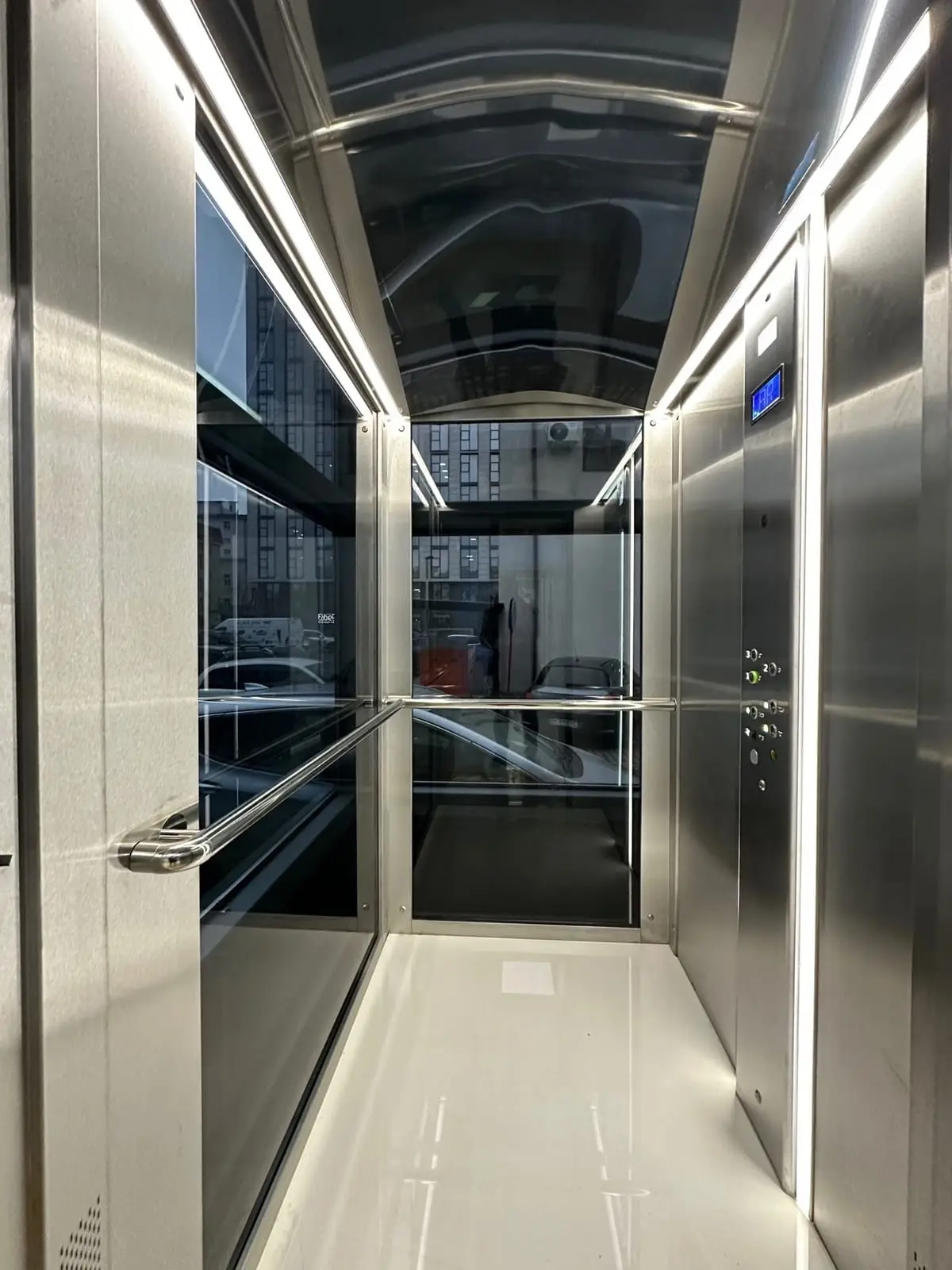
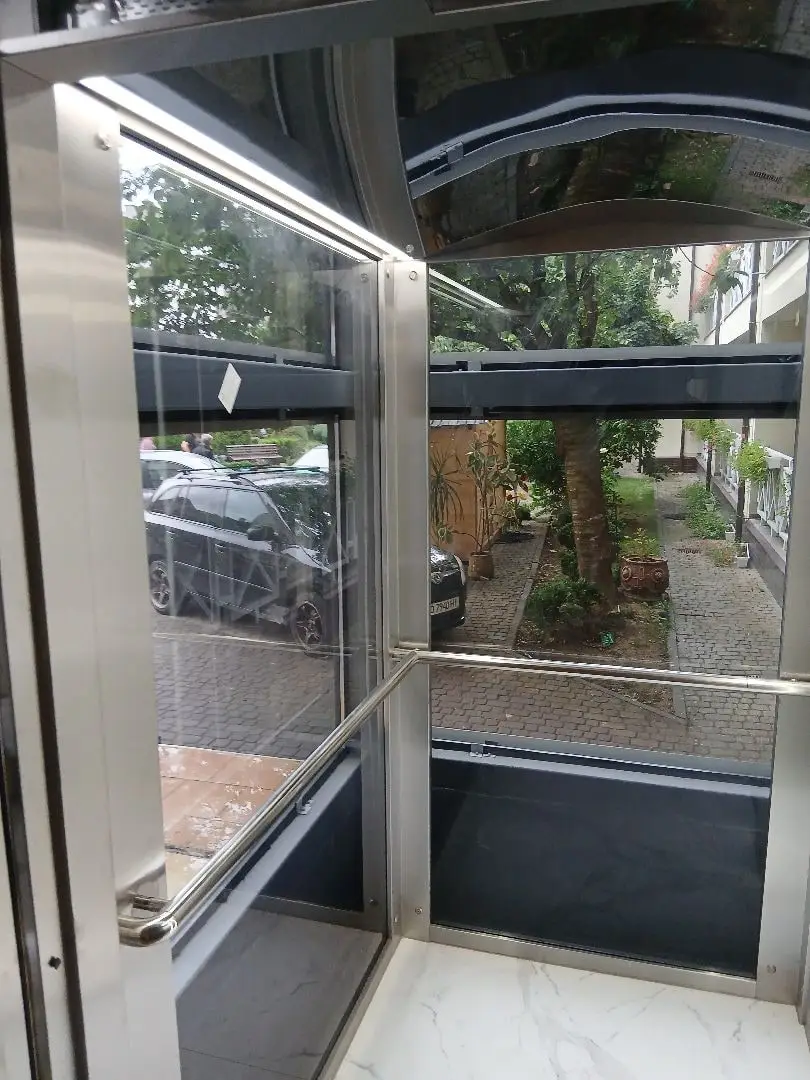
Goods lifts (freight elevators)
For warehouses, factories, shopping centres and kitchens.
For warehouses, factories, shopping centres and kitchens.
Designed to move goods, often together with an attendant. They feature a reinforced car, a floor built for heavy loads and extra-wide swing or sliding doors.
Request a goods lift quoteA goods lift is sized from the load, not from the car area. The first question is what exactly is being carried: a pallet on a pallet truck, rolls, furniture, a car. If a truck or stacker drives into the car, the weight of the machinery and operator is added to the load, and the floor must withstand the point load from the wheels. That means a different car frame and a different floor plate thickness.
The drive is chosen according to height and intensity of use. For a two- or three-level warehouse hydraulics usually wins: the load goes to the pit floor, and the power unit can be moved to an adjacent room; we take the maximum pipe length from the data sheet of the specific model. An electric drive is faster and handles up to a hundred and twenty starts per hour; at that rate a hydraulic system heats up and needs oil cooling.
Doors are where things break most often. Double-leaf swing doors are cheaper and give the full opening, but they are opened by hand, and in a warehouse they quickly pick up dents from pallet corners. Automatic sliding doors are more convenient, but the mechanism takes up part of the width. We also check whether the car is a through-type and where the lift is controlled from: from the car by the attendant or only from the landings.
What clients remember last: protecting the car interior - bump rails, handrails, steel chequer plate on the floor. In food and chemical plants stainless steel is used instead of powder coating, because pressure washing quickly finds any weak spot in a coating. And temperature: if the shaft opens into an unheated warehouse, the control cabinet and hydraulic power unit are prepared for winter separately.
A goods lift is intended for goods and may not allow people to travel in it, apart from an attendant. A goods-passenger lift is designed for both goods and passengers, so it has to meet the full set of safety requirements for carrying people - more accurate levelling, an appropriate car finish and communication devices.
The weight of the truck or stacker itself and the weight of the operator are added to the weight of the load. A separate check covers not the total weight but the point load from the wheels on the car floor - that is what determines the frame design and the floor plate thickness. That is why we ask for the make and service weight of the machinery, not just how many kilograms you carry per trip.
Swing doors give the full opening and cost less, but they are opened by hand, and in a warehouse they regularly get hit by pallet corners. Automatic sliding doors are more convenient and safer, but the mechanism takes up part of the width - with the same shaft, the clear entry is narrower. If pallets are loaded right up to the car walls, that is the decisive argument for swing doors.
It depends on the version. A lift with an attendant allows the person accompanying the load to be in the car and has the appropriate safety and communication equipment. A lift without an attendant is controlled only from the landings, and people must not ride in the car. This is recorded in the equipment's technical passport, so the decision has to be made at the ordering stage.
With a low travel and a heavy load, hydraulics usually wins: the load is transferred to the pit floor, no structure is needed above the shaft, and the hydraulic power unit is placed in an adjacent room a few metres from the shaft. The practical limit is about five or six floors. Under intensive use the oil heats up, and an electric drive with frequency control is the better choice there.
Yes. A goods lift is subject to the same scheduled checks, technical passport and logbook keeping, and periodic third-party inspection. In industrial settings the conditions are even harsher than in a residential building: dust, humidity, impacts on the doors. That is why we usually keep the inspection intervals for guide rails, safety gear and door mechanisms shorter than on passenger lifts.
For hospitals and medical centres: sized for stretchers and intensive care beds.
A glass car as an architectural feature of the building.
MRL - the equipment is housed inside the shaft.
Low travel, high rated load, quiet operation.
What determines the choice of lift: building type, number of floors, rated load, drive type and whether there is a machine room. Practical guidelines and common mistakes.
7 min readWhy the price is not quoted over the phone, which items actually make up the cost of a lift replacement, what drives the cost up and which benchmark you can check in the open register.
9 min readChoose what you need: an engineer will contact you within one working day, select a model and calculate the cost.
Or just give us a call: +38 (050) 585-39-28 ·+38 (063) 283-31-48 ·+38 (096) 901-76-50