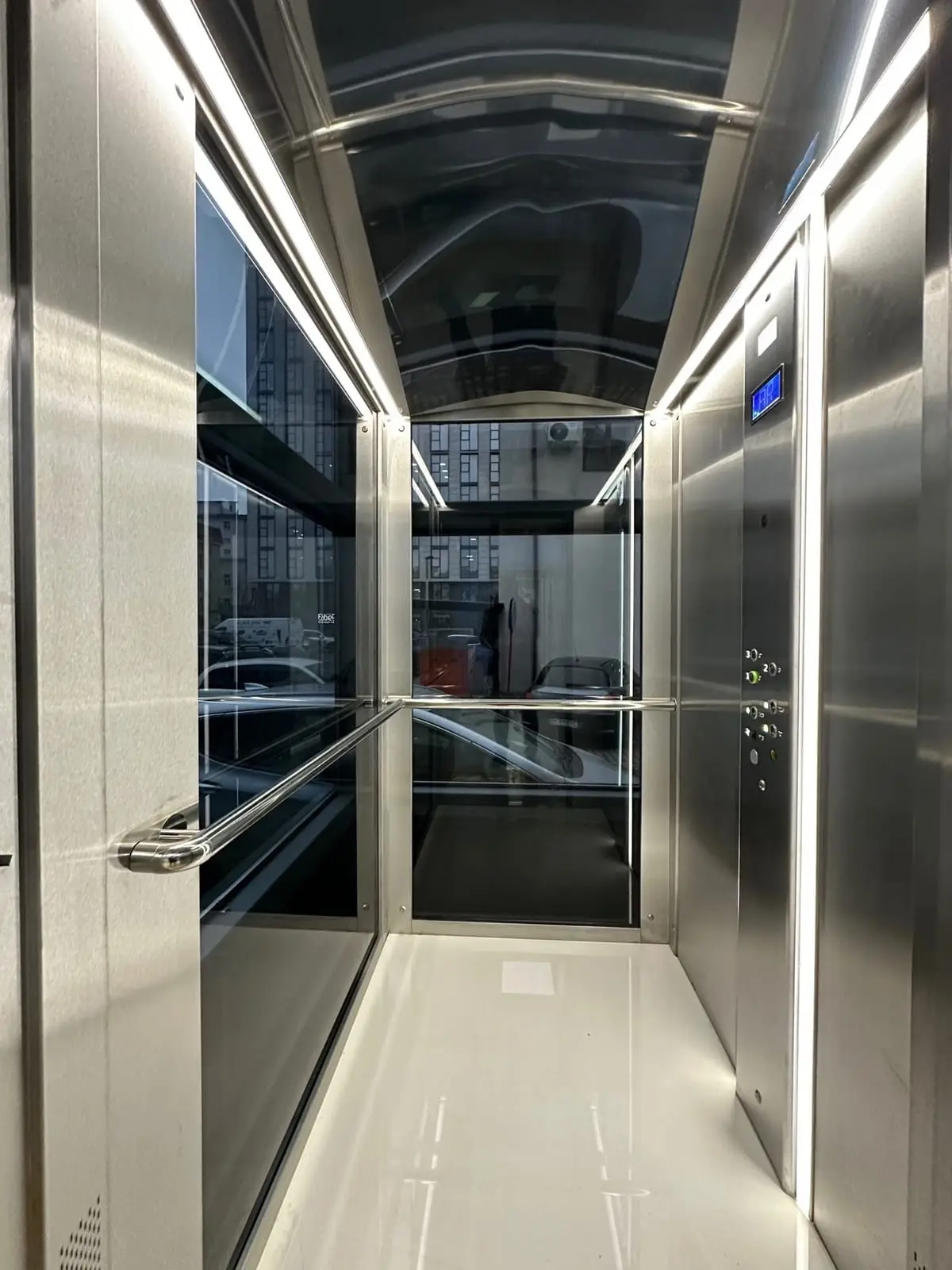
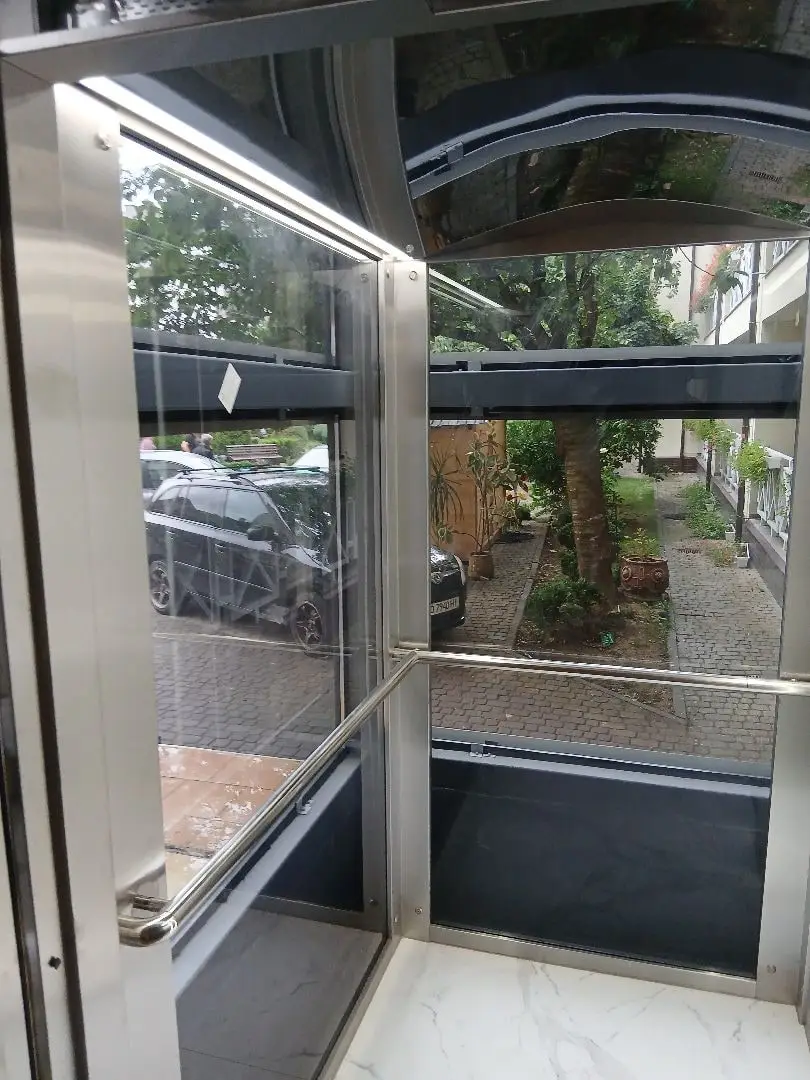
Panoramic lifts (glass elevators)
A glass car as an architectural feature of the building.
A glass car as an architectural feature of the building.
The car is fully or partly glazed, and the shaft is a steel frame with glass. Used in shopping centres, hotels, business centres and private houses when the lift is meant to be part of the interior.
Request a panoramic lift quoteA panoramic lift is the architect's decision, but the lift engineers deal with the consequences: a project often reaches us with the facade already finished and no room for the counterweight. A glass shaft has no solid walls to fix the guide rail brackets to, so the steel frame is designed together with the lift manufacturer - not after it has been welded to an architectural sketch. This is the first thing we ask about on such a project.
The key question before costing is how many sides must be transparent. A car with one glass side and three solid ones costs substantially less than a round car glazed all the way round: that one needs curved laminated glass, a custom car frame and non-standard doors. We also check straight away whether the shaft stands outdoors: if so, sealing, pit heating and pit drainage are added.
Operation is down to earth: the glass has to be cleaned, and on the outside of the shaft that means either a rope access technician or a maintenance platform provided for in the design. In a shopping centre atrium the sun comes into play - without tinting, the car turns into a greenhouse in summer, so forced ventilation is not a whim here. One more thing: a panoramic lift cannot handle heavy traffic. The cars are usually smaller than standard ones, the speed is moderate, and the attractive curves eat into the usable floor area.
Yes. A panoramic lift can be installed as an add-on against the facade or in an atrium, with a steel-frame shaft. For an existing building this is often simpler than building a reinforced concrete shaft inside, but it requires a design and approval of the facade alteration.
The difference has three components: curved or large-format safety glass in the car, a steel-frame shaft instead of ready-made reinforced concrete walls, and non-standard doors along with the car frame. A car with one glass side costs moderately more; a round car glazed all the way round costs substantially more. Only a calculation based on the dimensions of the specific building gives an exact figure.
The car and the shaft enclosure use impact-resistant laminated glass (triplex) or toughened glass - glass that does not break into sharp shards. For curved cars the glass is bent at the factory to the shape of the frame and cannot be adjusted on site. That is why it makes sense to order a spare panel together with the lift in case of damage.
Yes, but it takes a different specification: shaft sealing, pit heating and drainage, frost-resistant guide rail lubrication, heating for the control cabinet and sometimes the car as well. Most often the problem is not the mechanics but water - meltwater from the facade finds its way into the pit if drainage was not designed in at the project stage.
When it is moved to the facade or into an atrium - yes. A conventional lift shaft takes up about four square metres on every floor, and in a retail or office building that space has a real rental value. But the saving is not free: you add the steel frame, the glazing and upkeep of the facade structure.
MRL - the equipment is housed inside the shaft.
Low travel, high rated load, quiet operation.
Small service lifts for restaurants and hotels.
Vertical and inclined platform lifts for barrier-free access.
The Chernivtsi Regional State Administration building is a monument of national significance. How we added a glass shaft on its own foundation to the courtyard façade, turned windows into doorways and installed an Izamet panoramic lift without a single new opening through the historic wall.
6 min readMP lifts from Seville: in-house electronics and traction machines, an open (non-proprietary) controller, EU certificates, two factories. What we check in a manufacturer before offering it to clients, and what ordering an MP lift with installation and service from Portal looks like.
11 min readWhat lift cars are made of, which finish options are available and how to choose materials for the building type and intensity of use.
5 min readChoose what you need: an engineer will contact you within one working day, select a model and calculate the cost.
Or just give us a call: +38 (050) 585-39-28 ·+38 (063) 283-31-48 ·+38 (096) 901-76-50