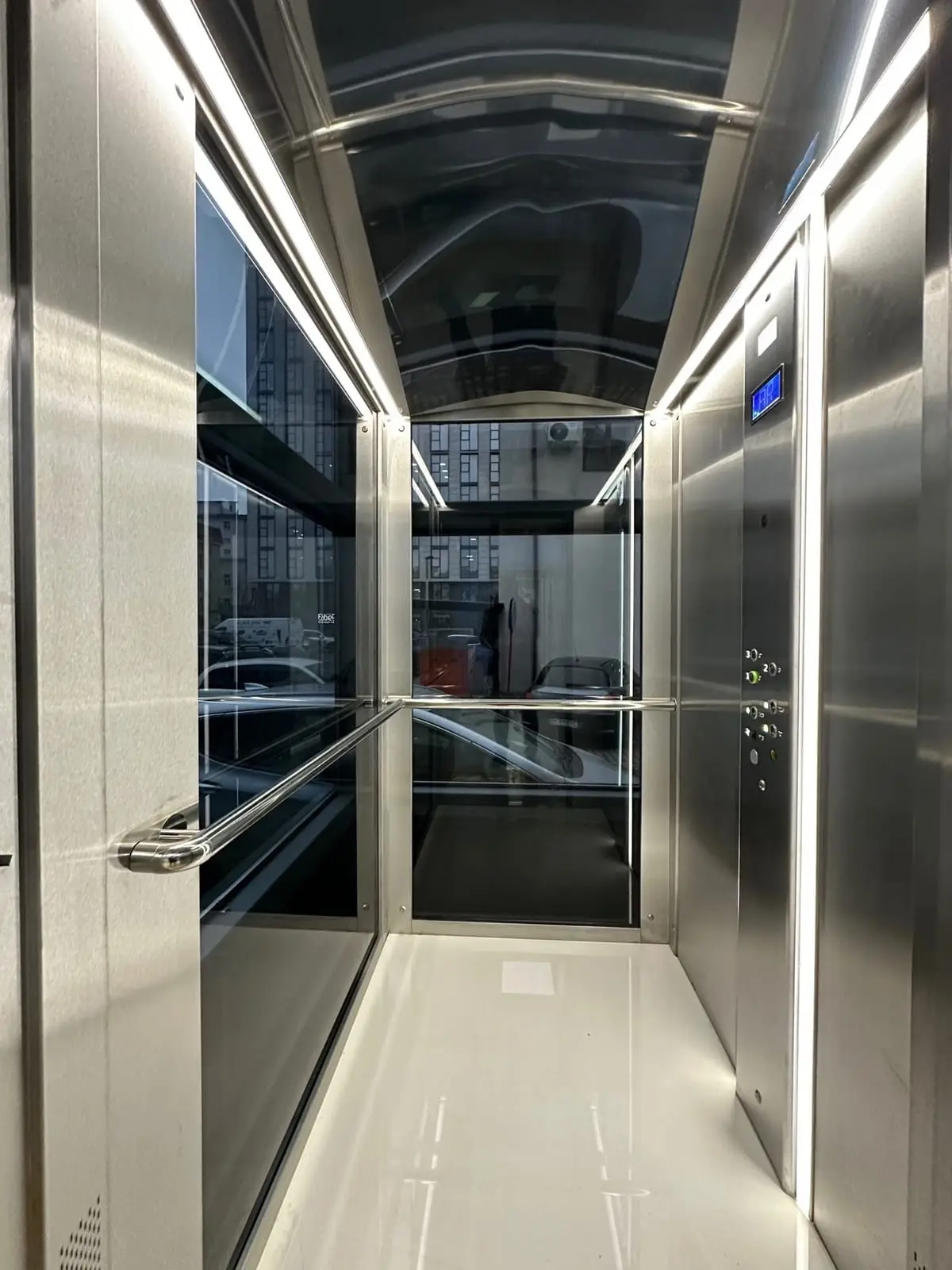
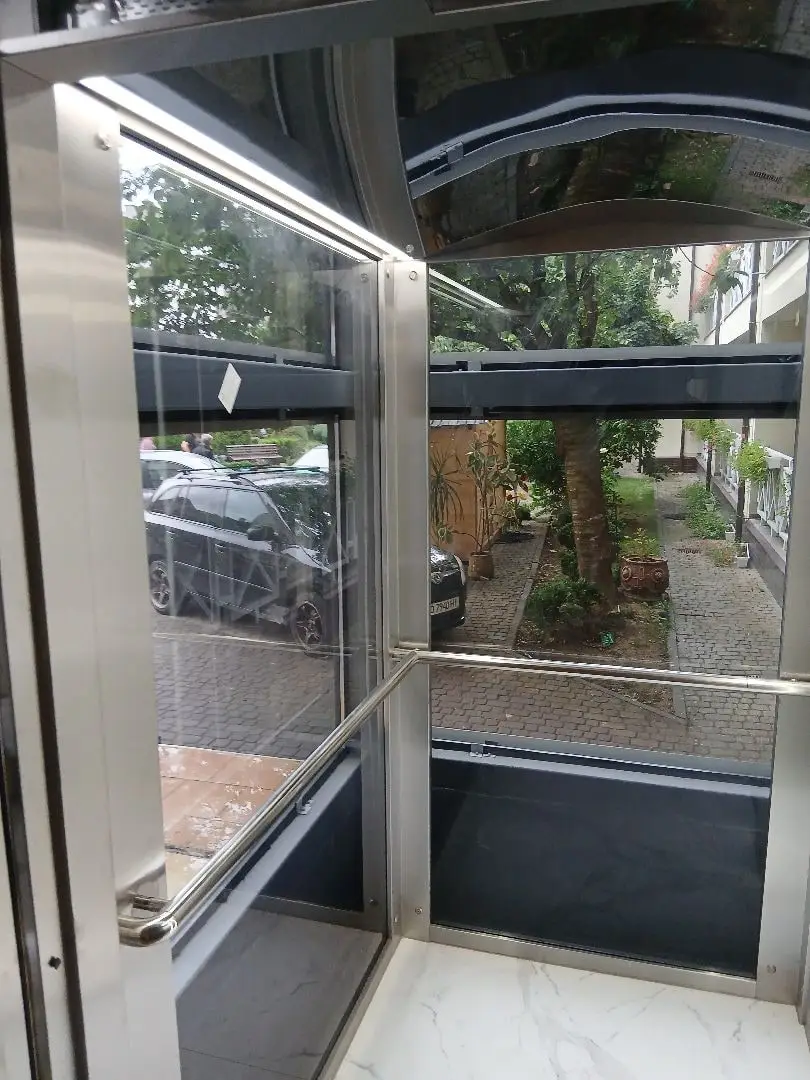
Hydraulic lifts
Low travel, high rated load, quiet operation.
Low travel, high rated load, quiet operation.
The car is driven by a hydraulic cylinder. They need no machine room above the shaft, handle heavy loads and provide a very smooth ride. Ideal for low-rise buildings and heavy goods.
Get a quote for a hydraulic liftThe power section of a hydraulic lift is not a traction machine above the shaft but a hydraulic power unit: an oil tank, a pump submerged in it and a valve block. The unit, together with the controller, is placed away from the shaft - in a utility room, under the stairs, behind a wall. In reconstruction projects this saves the day: there is not a single spare metre next to the shaft, but a storeroom turns up behind the wall in the corridor, and everything fits in there.
The second feature is where the weight goes. The cylinder force is transferred to the pit floor rather than to the slab above the shaft, so the top of the shaft does not need strengthening. For an add-on steel-frame shaft or an old building whose floors were designed without a lift, this is the deciding argument. The shaft needs only one load-bearing wall - the rest is closed in with lightweight panels or glass.
The price for this is paid in speed and duty cycle. The working range of hydraulics is 0.15-0.63 m/s, and by the sixth floor a passenger already notices that the ride is long. The pump heats the oil, so the drive does not like continuous starts: in an apartment block with heavy traffic it will overheat, the thermal protection will trip - and the lift will stop to cool down. Where the car runs all day without breaks, we don't recommend hydraulics: that is a job for a traction drive.
On the other hand, a power cut here does not mean a car stuck for an hour. The oil can flow back by gravity: just open the valve - and the car descends to the lowest stop and the doors open. The power unit is fitted with a battery-powered emergency lowering device that does this automatically; without it a technician opens the valve by hand, so check the specification for this option. In winter, in an unheated add-on structure, the oil thickens and the first trips are jerky - on outdoor shafts we fit tank heating and insulate the power unit room.
A hydraulic lift makes more sense for a low travel height - up to 5-6 floors - and a high rated load. It needs no machine room at the top, and the load is transferred to the pit floor rather than the top of the shaft, which simplifies the building structure.
The maximum pipe length is set by the manufacturer for each model: as the length increases, efficiency drops and pressure losses rise, so the figure is taken from the technical data sheet, not from someone else's experience. The room must be heated, accessible for maintenance and fitted with a drip tray in case of an oil leak. Most often it is a storeroom, a utility room or a corner of the plant floor next to the shaft.
The car will descend to the lowest stop under its own weight - the oil flows back into the tank through a valve. If the power unit has a battery-powered emergency lowering device, the lift will do this by itself and open the doors within seconds. Without such a device a technician opens the valve, so for sites with an unreliable power supply this option is included in the order from the outset.
It depends on the layout. A direct-acting cylinder under the car needs a borehole for the full travel height - this means separate works involving ground investigation and waterproofing. The alternative is side-mounted cylinders with rope multiplication: they stand to one side in the shaft, the car travels twice as far as the ram, no borehole is needed and the pit is standard. The layout is chosen based on the travel height and ground conditions.
Far fewer than a traction lift: the limit is set by oil heating, and the manufacturer states it in the technical data sheet together with the permissible duty cycle. Exceed it and the thermal protection trips, and the lift stops to cool down. That is why hydraulics are not suitable for a residential building with heavy traffic, but in a warehouse with a few dozen pallet lifts per shift they run for years without complaint.
The ram seal wears over time, and a leak in the pit is a typical sign of a neglected lift. With proper maintenance the seals are replaced on schedule, a drip tray is placed under the cylinder and the tank level is checked according to the scheduled maintenance plan. The problem is not the drive itself but whether the site has any maintenance at all.
Small service lifts for restaurants and hotels.
Vertical and inclined platform lifts for barrier-free access.
For residential buildings, offices, hotels and public buildings.
For warehouses, factories, shopping centres and kitchens.
MP Mobi is a vertical platform lift from Spanish manufacturer MP that works like a regular lift (elevator): car doors, one-touch call, pit from 200 mm, up to 1000 kg, battery-powered rescue. Who it suits and where its limits lie.
7 min readA chair stair lift, a home lift with no pit, a PVE pneumatic lift, a Cibes screw-driven platform lift or a hydraulic lift: which of them will actually fit in your house.
9 min readLift shaft plan dimensions, a 1200-1400 mm pit and 3600-4000 mm headroom for a 1.0 m/s lift, and when 50-150 mm is enough. What to measure before pricing.
5 min readChoose what you need: an engineer will contact you within one working day, select a model and calculate the cost.
Or just give us a call: +38 (050) 585-39-28 ·+38 (063) 283-31-48 ·+38 (096) 901-76-50