

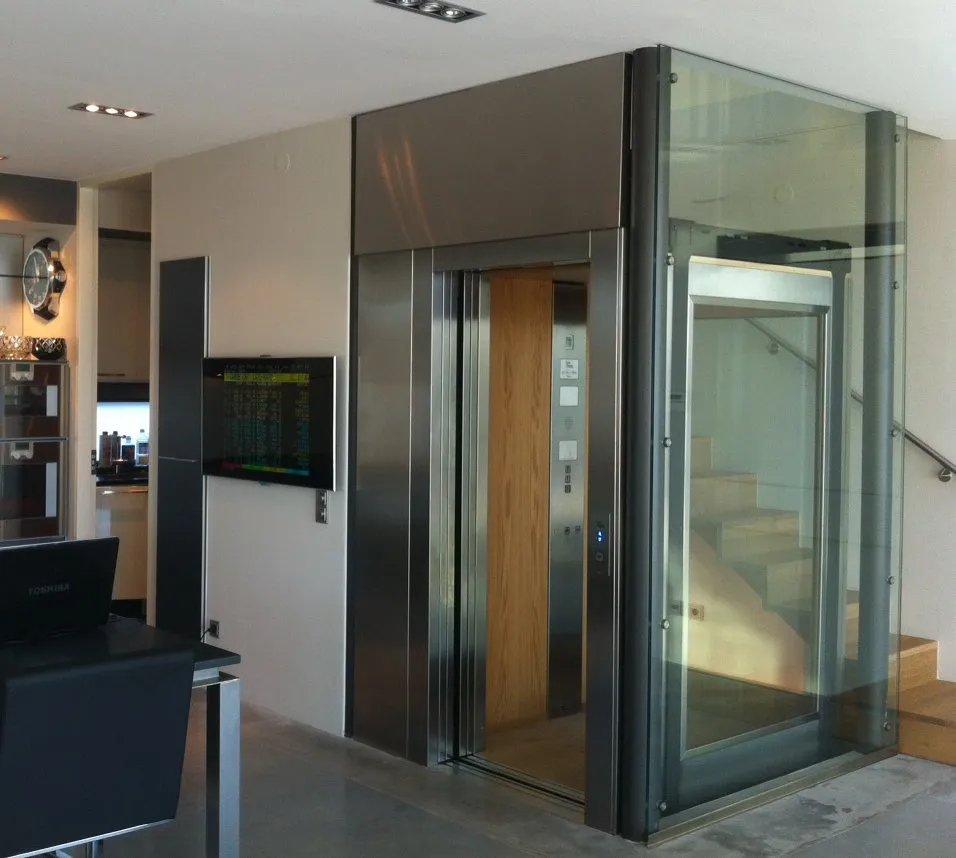
"What can we put in a house that has neither the pit nor the headroom for a regular lift?" We hear this almost every week. For such cases, the range of Spanish manufacturer MP, whose lifts we supply and install, includes the Mobi vertical platform lift. Below is our view of this machine: what is genuinely useful about it, how it differs from other home lifts, and where it is better avoided.
Mobi in brief
It is a hydraulic vertical platform lift with a speed of 0.15 m/s and up to six stops. Legally it is not a lift: the manufacturer builds it under the EU Machinery Directive, not the Lifts Directive. But its design is closer to a lift than most platform lifts: an enclosed car, automatic car doors, landing call buttons and a controller with a full set of safety functions.
A speed of 0.15 m/s means roughly twenty seconds per three-metre floor. That is enough for a house or a small public building. It is not enough for a multi-storey block, and the manufacturer does not offer it for one.
Car doors: what really sets Mobi apart
Most platform lifts and home lifts travel without car doors. The passenger stands on the floor while the shaft wall moves past. That is why such machines use hold-to-run control: the platform moves while you hold the button and stops as soon as you let go. For someone with a tremor or weak hands, or for a child, this is inconvenient and sometimes simply impossible.
The Mobi car has automatic sliding folding doors. Hence a different control logic: press the floor button once and the car travels on its own, like a regular lift. The manufacturer puts this first in its catalogue, and we agree. For anyone who rides it every day, the difference is noticeable within a week.
Two versions: for public buildings and for homes
Mobi comes in two versions. The standard one is designed for public buildings and built with the same technology as lifts for heavy-duty use. Mobi HOME is intended for private houses. The car sizes are the same; the rated load differs:
| Car, width × depth | Mobi / Mobi HOME |
|---|---|
| 1000 × 900 mm | 320 kg, 4 persons / 225 kg, 3 persons |
| 1000 × 1250 mm | 480 kg, 6 persons / 315 kg, 4 persons |
| 1100 × 1400 mm | 630 kg, 8 persons / 385 kg, 5 persons |
| 1100 × 2100 mm | 1000 kg, 13 persons / Mobi version only |
A 1100 × 1400 mm car easily takes a wheelchair user together with an attendant. The largest, 1100 × 2100 mm for 1000 kg, is available only in the public-building version: it is chosen when you need to move a stretcher trolley, a loaded cart or simply a lot of people at once. A tonne of load is rare for a platform lift. The home lifts we work with are usually rated for 250-300 kg.
What the building needs
The best thing about Mobi is the pit. The manufacturer needs only 200 mm, or 150 mm at extra cost. A regular passenger lift needs a metre or more. In an existing house, the difference between "raising the floor by twenty centimetres" and "digging a concrete pit below the floor slab" often decides whether there will be a lift at all.
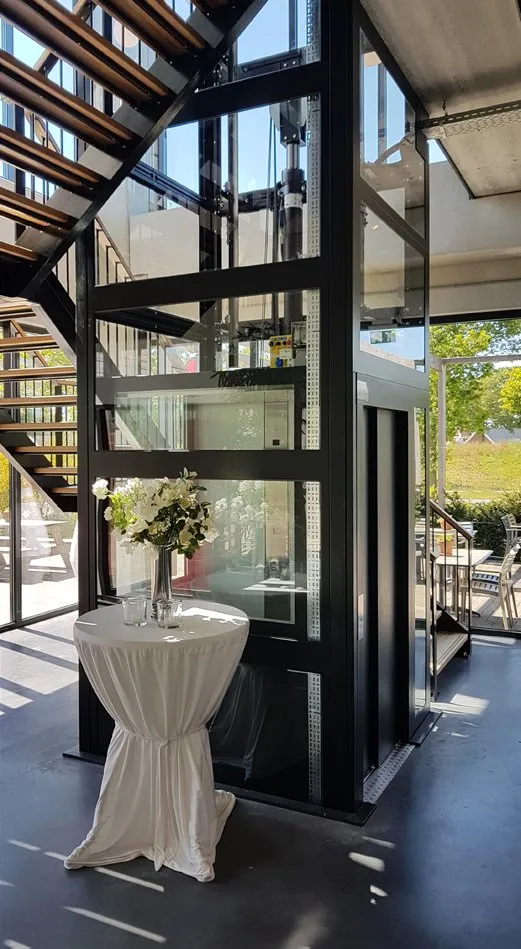
The platform can be installed inside the building or outside, in a masonry shaft or a glazed steel structure. We make the shafts ourselves, including add-on shafts attached to the façade, so it is a workable option for a house with no room inside. We calculate the shaft dimensions and the headroom (top floor height) for the specific car from the manufacturer's drawings after the site survey. We make no promises based on guesswork here.
The standard power supply is three-phase, 380-415 V, and the manufacturer offers 230 V single-phase as an option. This matters for a private house with a single-phase connection: there is no need to rework the incoming supply just for the lift. We decide where the hydraulic power unit goes together with the shaft during the site survey, not once the equipment has already arrived.
Safety, and what happens when the power goes out
For us this is not a theoretical question. Power cuts have become routine in recent years, and the first thing clients ask is what happens to the car when the power fails. In Mobi, automatic rescue is included as standard: running on its own batteries, the car travels to the nearest floor and opens its doors. If even that fails, the car is lowered manually with the emergency button on the hydraulic power unit.
The other safety features are the ones we are used to seeing in lifts:
- A rupture valve that holds the car if the hydraulics are damaged.
- Mechanical stops in the pit and at the top of the shaft, so the technician can work safely.
- Visual and audible overload alarm.
- Emergency car lighting and emergency communication.
- "Out of service" key switch on the landing control station.
- Anti-slip rubber flooring.
The platform can be connected to remote monitoring as an option. And the car light switches off on a timer when nobody is using it.
Car and finishes
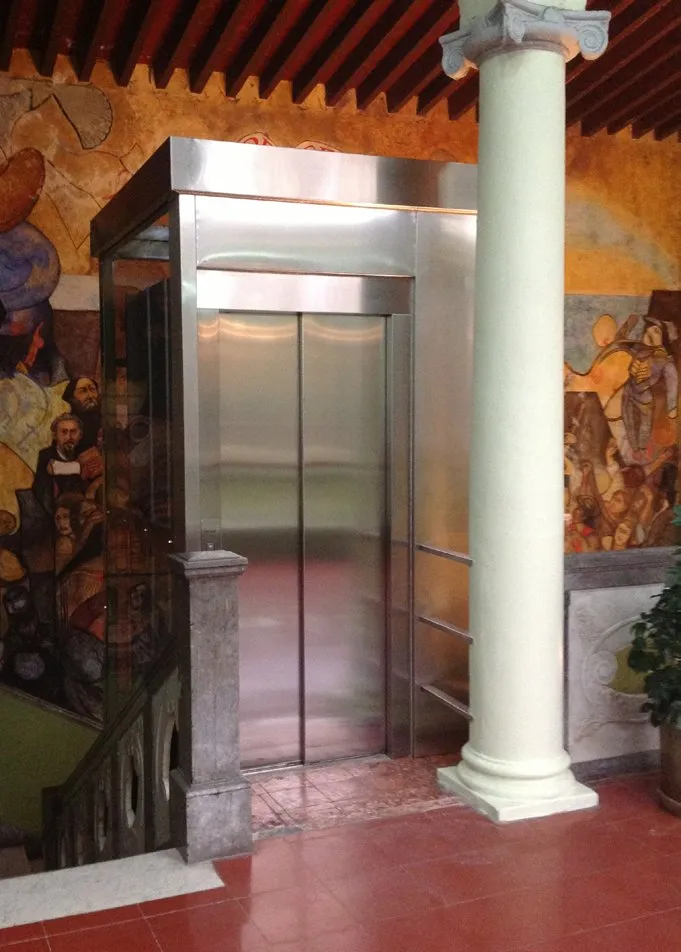
Mobi uses the same finishes as MP lifts. There are several car series: from powder-coated steel and laminate to stainless steel, coloured glass or photo-printed walls, as well as panoramic cars. Operating panels with 2.8″, 4.3″ or 7″ displays, a ceiling with LED lighting, rubber flooring in three colours. We choose the specification together with the client using samples, and agree the floor designations and display texts in Ukrainian before production.
Who Mobi suits and who it doesn't
We would consider Mobi in three cases:
- A private house on two to four levels that needs a proper car with doors, where a pit deeper than twenty centimetres is not possible.
- A small public building, such as an outpatient clinic, administrative services centre, school or church, where wheelchair access is needed but there is no room for a conventional lift.
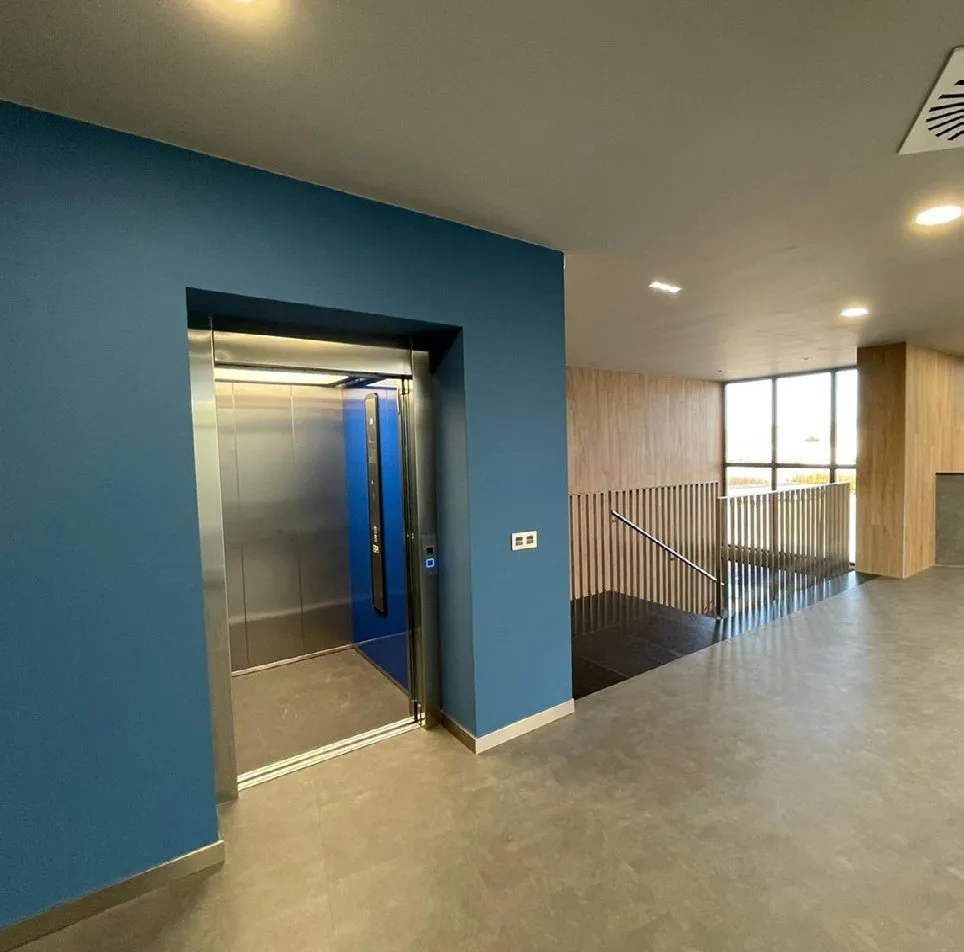
- Refurbishment of an old building, especially a listed heritage building, where concrete work in the basement is undesirable or prohibited.
There are also cases where we would rather suggest something else. If there are more than six floors or speed matters, you need a regular lift, and MP makes those too. If you only need to get over a few steps at the entrance, an open platform lift or an inclined stair lift is the simpler choice. MP, incidentally, does not make inclined platform lifts; we source those from other manufacturers.
Documents
Since Mobi is legally a machine rather than a lift, the manufacturer issues a declaration of conformity under the Machinery Directive, and in Ukraine it falls under the Technical Regulation on the Safety of Machinery. For the client, this means a slightly different set of documents for putting it into operation than for a lift. We prepare it ourselves, together with installation and commissioning.
Price and how to order
We do not publish prices on the website, for Mobi or for any other equipment. The cost depends on the number of stops, the car, the shaft and the finishes, and an honest figure only appears after a site survey. The survey is free: leave your number in the form below or call us, and an engineer will get in touch within one working day.