OTIS Lifts
The world's oldest and largest lift company. The OTIS 2000 series was developed for the Ukrainian market and produced at the company's Kyiv plant, the first lift manufacturer in Ukraine to hold ISO 9001 certification.
The world's oldest and largest lift company. The OTIS 2000 series was developed for the Ukrainian market and produced at the company's Kyiv plant, the first lift manufacturer in Ukraine to hold ISO 9001 certification.
Otis starts with safety gear. In 1852 Elisha Otis built a device that holds the car if a rope breaks - and it was after this that buildings began to grow upwards. Next came the escalator, which won Otis the grand prix at the 1900 Paris Exposition and which gave the word "escalator" its lasting name, and the gearless electric traction machine of 1903, on which a whole generation of skyscrapers was built. What matters to the client today is not this history but what grew out of it: a huge service network and a manufacturing base that includes the Kyiv plant.
Technically, Otis is recognised by Gen2. Instead of steel ropes it uses flat polyurethane belts: three millimetres thick, thirty wide, with twelve thin steel cords inside. A belt like this bends around a small radius, so the permanent-magnet traction machine could be made about 70% more compact than a conventional one and placed inside the shaft - no machine room is needed. With the gearbox goes the oil, and with the ropes goes the metallic rustle over the sheave that you can clearly hear in a quiet entrance hall.
The OTIS 2000 series was designed for Ukrainian multi-storey residential blocks: rated load 400, 630 and 1000 kg, speed 1.0 or 1.6 m/s, travel up to 85 metres, car for 5, 8 or 13 passengers. A vandal-resistant car and operating panels are not an option here but a standard requirement for an apartment block - we come across this all the time in enquiries for older housing stock.
There is a flip side. Servicing the proprietary controller depends heavily on factory software, so a third-party company works within narrower limits than on lifts with an open controller. The belts have their own service life and are replaced as a set, not one rope at a time as on a conventional traction machine. We take on Otis lifts for both installation and maintenance, but we point this out before the equipment is chosen.
For residential buildings, offices, hotels and public buildings.
For warehouses, factories, shopping centres and kitchens.
For hospitals and medical centres: sized for stretchers and intensive care beds.
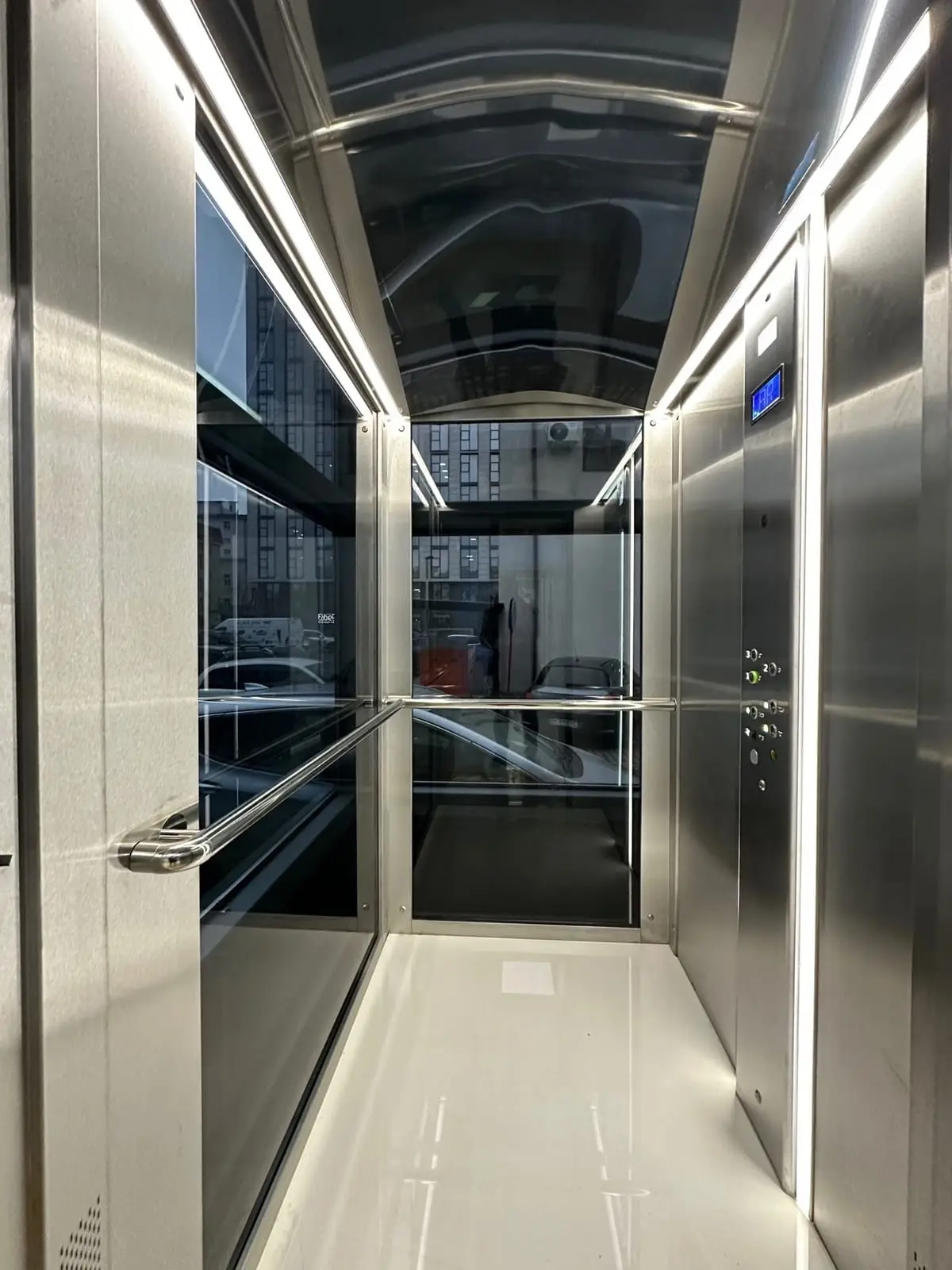
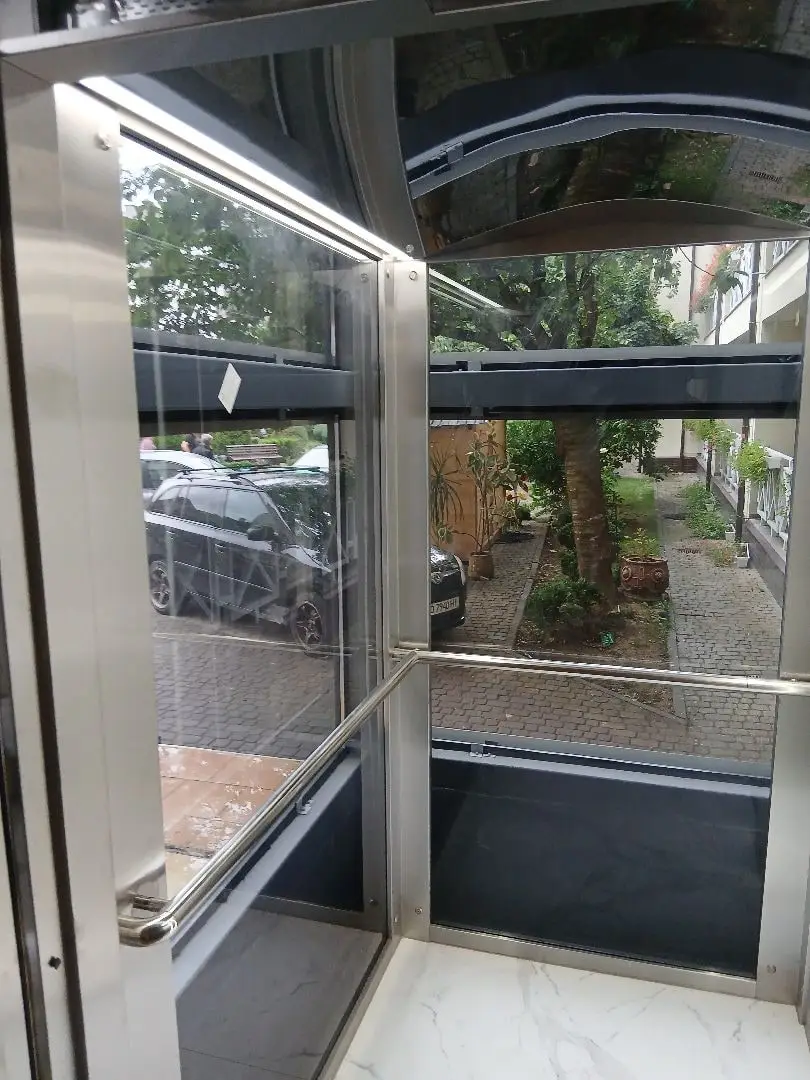
A glass car as an architectural feature of the building.
Yes. The OTIS 2000 series was developed for the Ukrainian market and made at the group's Kyiv plant; imported series come through a separate channel. Current availability of a specific model is confirmed by the supplier for each order. As the contractor, we handle installation, commissioning, putting into operation and ongoing maintenance. Configuration, specification and lead time are confirmed by the supplier: we do not quote lead times until we have written confirmation - in lift supply, it is the delivery date that slips most often.
The Gen2 belt is not rubber: it is twelve steel cords in a polyurethane coating. The coating protects the metal from corrosion and wear and needs no lubrication, and the belt itself is more flexible than a rope of the same strength. It has its own service life and is replaced as a set. In return you get a noticeably quieter ride and no machine room above the shaft.
Noticeably more expensive - both the equipment itself and the subsequent service. The difference is justified where brand recognition matters to tenants or where the client wants a single supplier for an entire property portfolio. For an ordinary multi-storey residential block we more often suggest Bulgaria's IZAMET or other European makers: in terms of specifications they do the same job for less money.
Yes, we can. We carry out scheduled inspections, replacement of worn components and emergency call-outs on equipment from any manufacturer. There is one limitation: in-depth diagnostics and reflashing the controller require manufacturer access, and we coordinate such work with the manufacturer's local office. Mechanics, landing doors, door operator, safety gear, guide rails, overspeed governor - all of this is fully within our scope.
Often, yes - which is exactly why this series is chosen for modernization. But headroom and pit have to be measured on site, not taken from a forty-year-old design: shafts in older buildings regularly deviate from the drawings by a few centimetres, sometimes more. We visit, carry out a survey and only then tell you what will fit.
What determines the choice of lift: building type, number of floors, rated load, drive type and whether there is a machine room. Practical guidelines and common mistakes.
7 min readWhy the price is not quoted over the phone, which items actually make up the cost of a lift replacement, what drives the cost up and which benchmark you can check in the open register.
9 min readChoose what you need: an engineer will contact you within one working day, select a model and calculate the cost.
Or just give us a call: +38 (050) 585-39-28 ·+38 (063) 283-31-48 ·+38 (096) 901-76-50