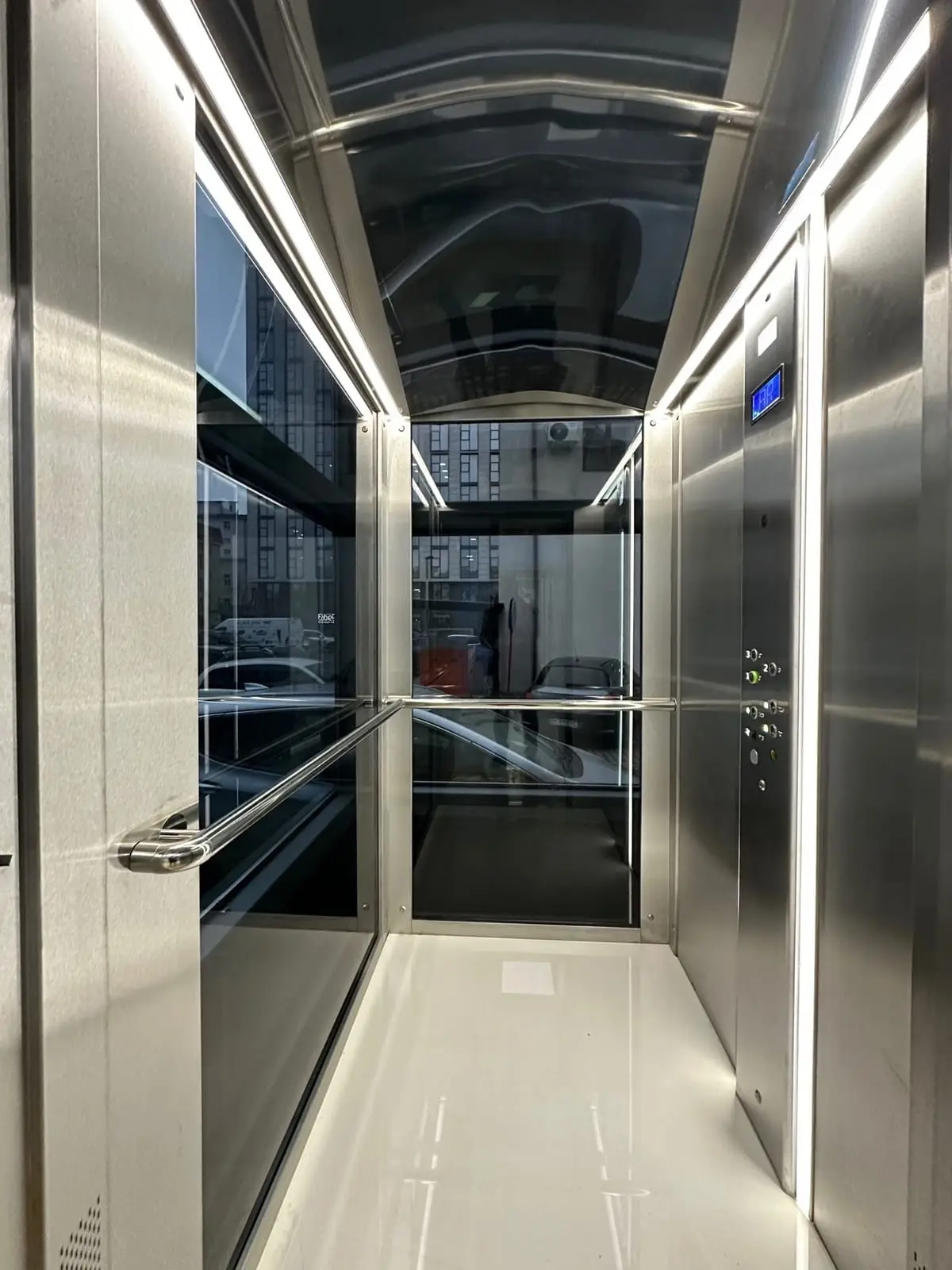
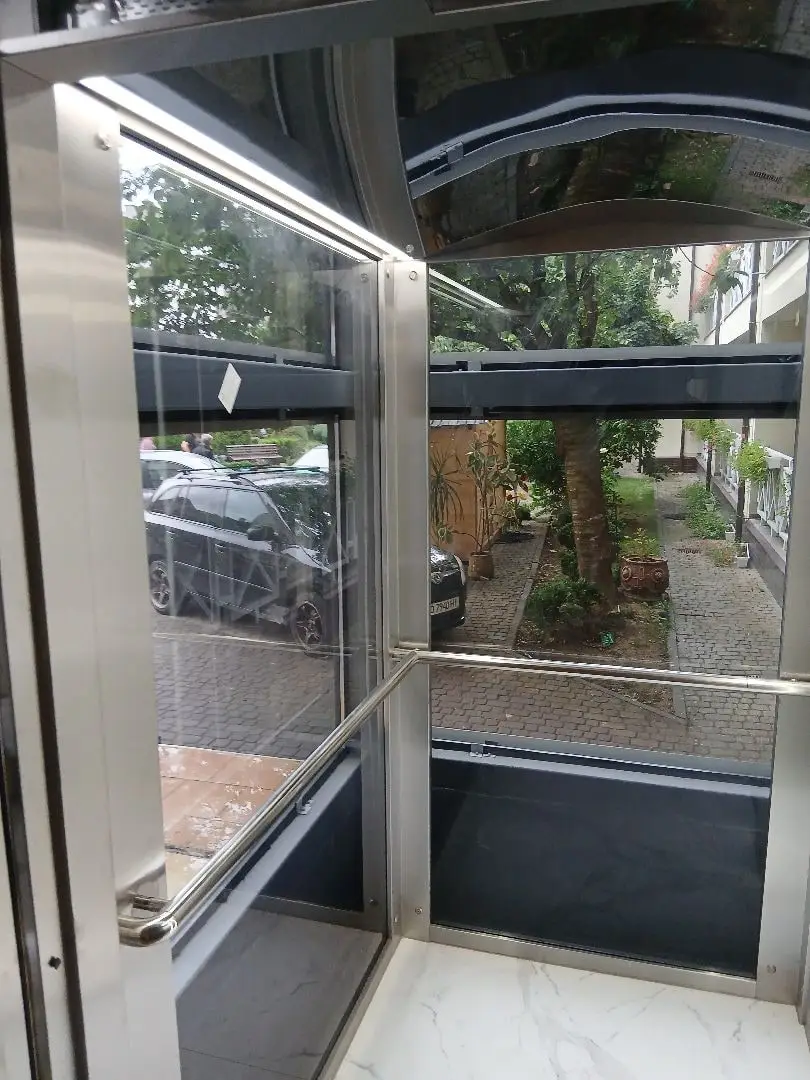
The lift has stopped, the doors won't open and someone is inside. If you are reading this on your phone inside the car, the first two sections are all you need; the rest can wait. If you are a neighbour and hear knocking from the shaft, your job is to use the phone, not your hands. The second half of the text is for the chair of the homeowners' association (OSBB): what to do so that calls like this become rare.
You are in the car: what to do
A car that has stopped does not fall. Overspeed is monitored by the overspeed governor: when it trips, it engages the safety gear, which holds the car on the guide rails. A stop between floors is usually a safety device tripping or a loss of power, meaning the lift has done exactly what it was supposed to do.
- Press the alarm button and wait for the dispatcher or the responsible person to answer. The dispatch communication unit runs on a battery and keeps the link for some time even after the building loses power.
- Give the address, the entrance and how many people are in the car. Say specifically if there is a child or an elderly person inside, or if someone feels unwell.
- Don't press the floor buttons one after another and don't bang on the doors. Smashed buttons are themselves one of the reasons lifts stop.
- Step away from the doors and wait.
- If there is no answer via the alarm button, call the maintenance company or the responsible person from your own phone - on the number the OSBB gave residents.
Why you must not open the doors yourself, and who is allowed to carry out an evacuation
If you remember only one sentence from this article, let it be the next one. The car may be stopped between floors, and an open landing door is an open drop. Anyone who climbs out through the gap on their own does so while the lift is, formally, still energized. That is why the rule is the same for everyone: no one touches the doors except trained personnel.
To neighbours already standing at the doors: don't prise the door panels apart, don't pass tools inside and don't advise the passenger to lever the doors open. The useful things you really can do are to make the call, tell the person in the car that the call has been taken, and stop anyone else from touching the doors until the crew arrives.
Evacuation is carried out only by trained personnel: with the power isolated and the car brought level with the landing. It is not a matter of "opening the doors with a key" but a sequence of steps, after which the doors are opened only once the car floor is level with the landing floor.
Only a specialized company with certified personnel and the necessary permits is entitled to maintain lifts. The state classifies lifts as high-risk equipment, so contractors are not hired "off the street". An OSBB's own electrician is not allowed to do this work: the issue is not qualifications but legal authorization.
Why lifts stop: what we see on call-outs
From experience: most emergency call-outs are not about a broken traction machine.
| Cause | What lies behind it |
|---|---|
| Misaligned door contacts | The lift won't move until the contact is restored - and that is correct behaviour, not a fault |
| Object between the door panels | The doors don't close fully, so the car stays at the floor |
| Smashed buttons | The result of vandalism - not covered by the maintenance contract |
| Flooded pit | After a downpour. In autumn the share of "wet" call-outs rises noticeably |
| Phase loss | The problem is in the building's power supply, not inside the lift |
In cities where we have crews, we usually get the lift running again on the spot. More complex failures come down to a spare part and a separate visit - we say so straight away, because there is no "tomorrow" without the part.
Who to call, and why without a contract there is no one to call
A lift must not be operated without a contract with a specialized company - this is a requirement of the safe operation rules, and every new building where nobody budgeted for it trips up on this. The contract is also needed to pass technical inspection and to keep the equipment's technical passport in order. But there is a practical side as well: it is the contract that ensures someone answers the call from the car.
For sites under our maintenance, the emergency line operates 24/7. We put a realistic response time in the contract: the drive to a remote town takes as long as it takes, and there is no point in pretending otherwise. Scheduled inspections, adjustments, minor replacements and emergency call-outs are included in the monthly fee. Major overhaul, the consequences of vandalism and flooding, and the building's electrics up to the incoming supply switch are not; we draw that line in the text of the contract, not "by arrangement".
For the OSBB chair: how to get fewer calls
Responsibility for the condition of the lift lies with the owner - the co-owners represented by the OSBB, or the building manager if the building has been handed over to them under a contract. A contract does not lift the obligations under the Rules for the Construction and Safe Operation of Lifts (NPAOP 0.00-1.02-08): you can change the contractor, but not the owner.
- A contract with a specialized company from the first day of operation, not from the first breakdown. Check the scope of work in it against the manufacturer's instructions for your particular model: DSTU EN 13015 provides the framework for such a contract.
- An order appointing the person responsible for organizing the operation of the lift, and occupational safety training for that person and for the chair - NPAOP 0.00-4.12-05.
- Working two-way communication with the car. Without it the lift will not be put into operation, and the passenger is left alone with a mobile phone that often has no signal in the shaft.
- A locked, dry and lit machine room, with controlled access.
- A dry pit, and the habit of not pouring water into the shaft after washing the stairs. This directly affects the number of call-outs in autumn.
- A call log. If the lift has stopped for the third time in a month, this should be on record, not just in residents' accounts.
A building with several entrances does not need its own dispatch centre: calls from the car are forwarded to the phones of the responsible persons and the emergency service, which also receive alerts when a landing door is opened or the power fails. Remote monitoring units also keep an event log, so the board can see when the lift stopped and whether the crew really came out.
When stoppages are no longer about repairs
A lift that stops every week is sometimes up against not a faulty contact but the end of its service life. The designated service life of a lift is usually 25 years, and once it has run out the equipment cannot simply be kept running "as it was": an expert inspection is required. The procedure for carrying it out and issuing the conclusion is set by methodology OMD 33497324.005-2014. The conclusion will state whether further operation is possible, for what period and on what conditions - usually with a list of mandatory replacements.
If the lift fails the inspection, operation is stopped. The car is de-energized, the landing doors are locked shut and notices are put up on each floor. We regularly see the "let it run until the residents' meeting" approach, and responsibility for the consequences of operating like this lies with the owner, not with whoever carried out the inspection.
Honest caveats
- We don't state crew arrival times in minutes on the website. They depend on the city and are set in the contract for each specific site.
- The battery in the dispatch unit keeps the link for a limited time. During long outages it is critical that the communication channel itself has power, not just the unit.
- GSM reception in the pit and basement is poor - an external antenna is almost always needed. It should be included in the cost estimate from the start, not after the first complaint.
- We do not supply or refurbish equipment from Russia or Belarus - including dispatch communication units.
What to do next
If someone is in the car right now, make the call instead of reading on. If you chair the board and want fewer calls like this, start with the lift's technical passport: it states the designated service life and the date the lift was put into operation. That, not the year the building was built, is the starting point for the conversation.
Next comes an engineer's visit. The engineer measures the shaft, pit and headroom, checks the steelwork and electrics, and as a result the board receives a costing with a list of works, not just a single total. We carry out the site survey and costing free of charge, however the conversation ends. Head office: Ivano-Frankivsk; branch: Lviv; plus a separate installation crew in Kyiv.